> For the complete documentation index, see [llms.txt](https://help.aphex.co/docs/llms.txt). Markdown versions of documentation pages are available by appending `.md` to page URLs; this page is available as [Markdown](https://help.aphex.co/docs/planner/features/gantt.md).
# Gantt
{% hint style="info" %}
**Who can use this feature?**
Project Users with Full Planner Access can create and open Gantt Views.
{% endhint %}
## Group the Gantt
***
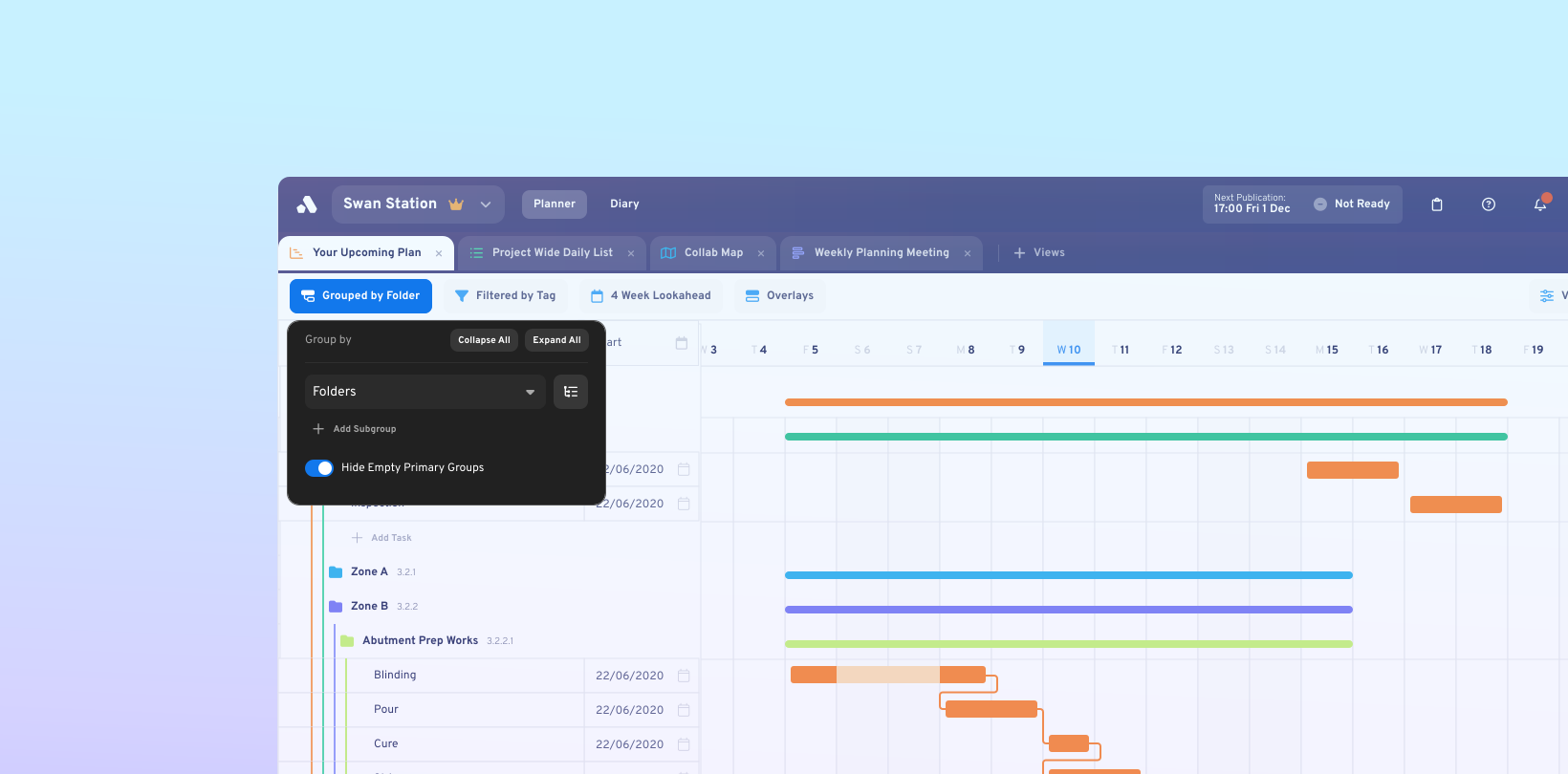
Gantt Views can be grouped by different properties within your plan to organise your Tasks in different ways.
**To change how the Gantt is Grouped:**
* Click the menu in the top left of the Gantt
* Select a Primary Grouping. Pick from `Folder`, `Owner`, `Package`, `Shift` or `Location`
* Optionally, select a Sub-Grouping to apply another level of structure beneath the Primary Group
* When `Hide Empty Primary Groups` is , only Groups that contain visible Tasks will show on the Gantt. Any Groups without Tasks in your current View will be hidden.
#### To Collapse and Expand Groups:
* Click the menu in the top left of the Gantt
* Select either `Collapse All` or `Expand All`
Group By Rules
* Choose a Primary and Sub Grouping to shape how your Gantt is displayed\
e.g. Group by Subcontractor, then by Shift, to see separate swimlanes for each combo
* The layout updates instantly as you change grouping options
* All Primary groupings, except Folders, can be rearranged into a custom order, per user
* Sub Groupings only show groups that contain tasks - empty groups won’t appear
* Folder Grouping can be switched between a nested Tree Mode and a Flattened Mode, which condenses the Folder path into a single row to save vertical space on the Gantt
## Setting the Date Range
***
Gantt Views are very flexible and allow you to visualise any set of Tasks over time.
**To change the visible Date Range on the Gantt:**
* Click at the top of the Gantt
* Yours might also look similar to or
* Choose your preferred mode from the selector:
* - Select from common options like "Next 30 Days", "Next 3 Months", "All Tasks", etc.
* - Enter the number of days before and/or after today to create a moving window.
* - Pick specific start and end dates using the date pickers.
* Optional: Toggle "Show Surrounding Weeks" to add an extra week of visibility on either side of your selection
Date Range Options
**Preset**
Preset mode offers quick-select options for the most common project viewing timeframes. Simply click on any option to instantly apply that date range to your timeline. These ranges automatically recalculate based on today's date.
| Date Range | Range |
| ---------------- | ---------------------------------- |
| X Week Lookahead | Today + (Project Lookahead Period) |
| Next 30 Days | Today + Next 30 Days |
| Next 3 Months | Today + Next 12 Weeks |
| Next 6 Months | Today + Next 25 Weeks |
| Next 12 Months | Today + Next 52 Weeks |
| All Future Tasks | From Today to Last Task |
| Project to Date | From First Task to Today |
| All Tasks | From First Task to Last Task |
**Rolling**
Rolling mode creates a dynamic window of time that stays centered around today and automatically shifts forward as time passes. Enter the number of days you want to see before and/or after the current date.
| Input | Calculated Range |
| --------- | ------------------------------------ |
| Forwards | Today + specified days into future |
| Backwards | Today - specified days into past |
| Combined | Full rolling window centred on today |
**Fixed**
Fixed mode gives you complete control to select any specific start and end date. Use the date pickers to choose exactly which timeframe you want to view. Unlike other modes, this range stays fixed and doesn't change as days pass.
| Input | Calculated Range |
| ---------- | ---------------------------------- |
| Start Date | Selected start date |
| End Date | Selected end date |
| Combined | Fixed range from start to end date |
**Show Surrounding Weeks**
This toggle is available in all three modes and provides quick additional context around your selected range. When enabled, it adds one week of visibility before your start date and one week after your end date, making it easier to see what's coming up next or what just happened without changing your core date selection.
| Setting | Effect on All Mod |
| ------------- | --------------------------------------------------------------------- |
| Off (default) | Displays exactly the calculated range, no additions |
| On | Adds 1 week before start date + 1 week after end date to visible area |
## Filtering the Gantt
***
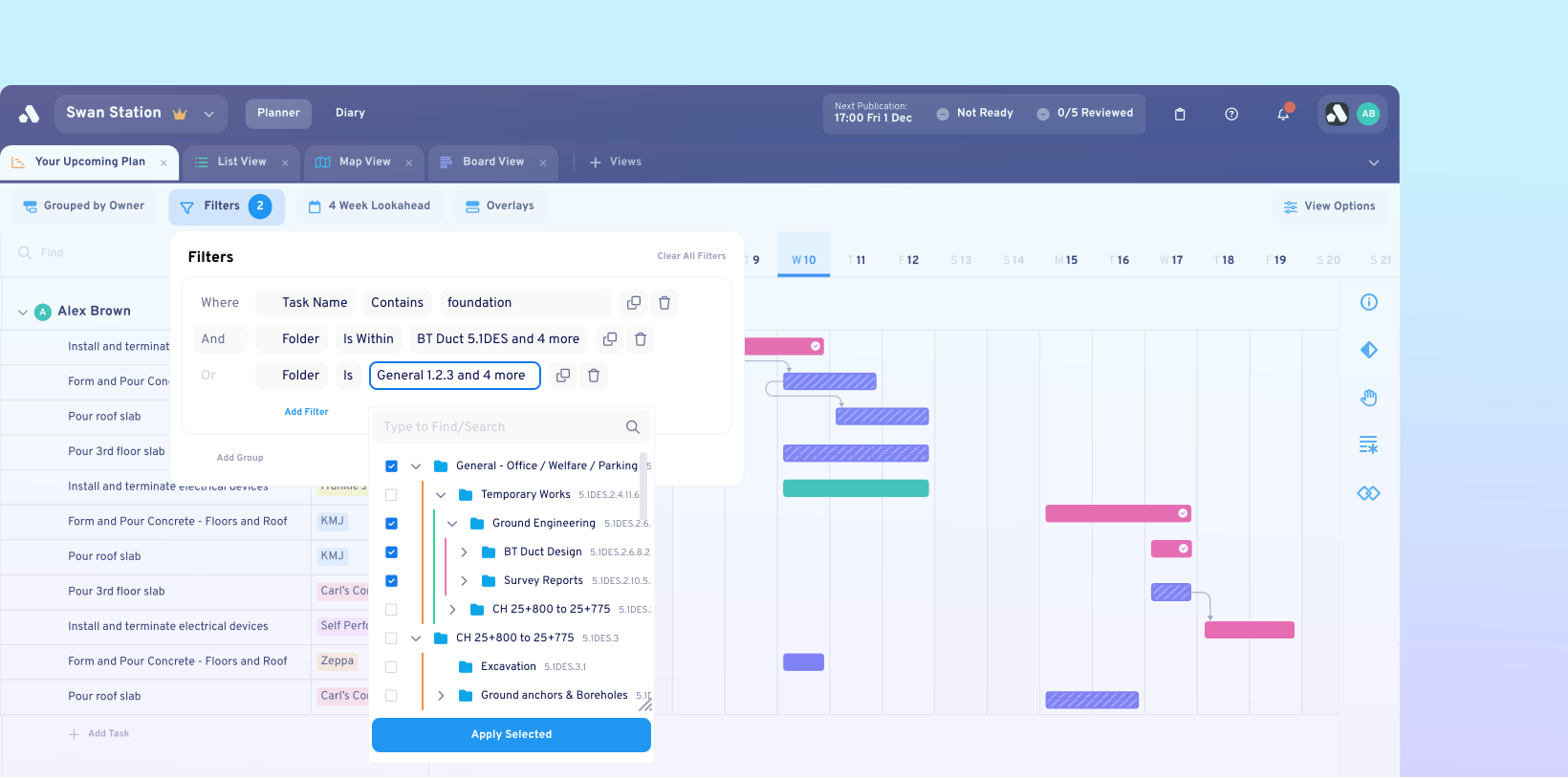
Filters in Aphex let you show only what matters, whether that’s Tasks with certain properties, or ones that are missing something. Keep it simple or build something more detailed, it's up to you.
**To filter the Tasks you see in a Gantt View:**
* Click at the top of the Gantt
* In the dropdown that appears select and choose the property you'd like to filter by
* Change the logic from options like or to or to hide or reveal the relevant Tasks
* Click to swap between and
**Using Filter Groups:**
* Groups are helpful when combining logic and logic in your filter
* Click .svg?alt=media\&token=a80b1956-dc49-4026-a929-c91abb20ed31) to create an additional filter group
See also: creating & sharing ViewsFilter Logic and Rules
* All Task Properties as well as Unresolved Issues can be applied as a filter
* Archived values that are still in use will appear as filter options. Unused archived values will be hidden from the filter options
* Tasks that do not match the filter criteria will be hidden from the Gantt
## Gantt Empty States & Hidden Items
***
If your Gantt looks empty, it's usually because settings like Filters, your Date Range, or the Hide Empty Groups toggle are hiding your tasks or groups. Aphex provides clear messages and icons to help you adjust your view.
**Empty Gantt Message:**
When no tasks or groups are visible, a message will appear in the Gantt:
> **Looks like your Gantt is empty**\
> Try adjusting   or  to reveal activities and groups
To reveal your tasks, simply click the highlighted   or  in the message to open the relevant panel and adjust your view settings.
**Hidden Groups Notification:**
When the Hide Empty Groups toggle is active, a notification appears at the top of the Gantt if any groups (Folder, Location, Owner, Package, Shift or Subcontractor) are hidden as a result:
> **\[X] Hidden \[Group Type]**\
> Adjust your   and  configuration to reveal hidden groups
To reveal hidden groups:
* Click the highlighted   or  in the message to open the relevant panel and adjust your view settings.
* Open `[View Settings Icon]` and set the Hide Empty Groups toggle to `[Toggle Off Icon]`.
**Hidden Items in Folders:**
Look for the  next to a Folder Row. This icon indicates the folder contains subfolders, but they are hidden by your current Filters, Date Range, or Hide Empty Toggle.
To temporarily reveal the hidden folers:
* Click the  next to the folder name. This displays the contents without changing your overall Gantt view.
## Task Sort Order
***
Tasks on the Gantt will always be sorted by Start Date - the earlier a Task starts, the higher it will appear within it's grouping.
Aphex will hold the position of your Tasks while you make edits, and then when you're ready to re-apply the Sort Order, click in the bottom left corner.
Refreshing your Aphex window will also trigger the sort order to be re-applied to your Gantt View.
Sort Order Logic
The Gantt Sort Order is fixed, and will always follow this logic:
* First it will sort tasks by Start Date
* If the Start Date is the same, it will then check End Date
* If the End Date is the same, it will then apply Alphanumeric sorting
## Gantt Zoom
***
You can view your projects on a range of time scales, from a single day to a full year:
* Head to the bottom-right corner of your Gantt
* Use the menu to switch between `Day`, `Week`, `Month`, or `Year`
* The Gantt will instantly update to show your plan on the scale you’ve selected
## Overlays
***
Overlays let you layer in things like baselines, critical path visibility, or daily resource demand. This means you can add extra context to your Gantt without changing up or leaving your View.
#### **To turn Overlays on and off:**
* Click at the top of the Gantt
* Select from `Resource`, `Baseline`, `Critical Path`
* To compare the Live Plan to a previous week, select `Baseline`
* This will show a list of all Published Versions, and all Master Schedule Imports
* Select any option to see how how your current plan compares to your baseline
See also: Resource Overlay and Critical Path
## Group Dates & Durations
***
When viewing your Gantt, Aphex automatically calculates a Start Date, End Date, and Duration for Folders, Packages, and Parent Tasks. These adjust based on what’s visible in your View and which working calendar you chose to apply.
#### **To change your Group Duration Calendar:**
* Click
* Select `Group Duration Calendar`
* Choose one out of: `Project Default`, `5 Day Week`, `7 Day Week`
#### **To view Group Durations & Dates on the Gantt:**
* Open the Column Picker and toggle `Duration` or `Start` / `End`
* These values change dynamically with Filters or Date Range updates
* Filtered values are marked with a icon so you know they’ve been adjusted
* Hover over the icon to see:
* The Filtered value
* The Total value
See also: Task CalendarsGroup Duration Calendar Options
| Calendar Option | Description |
| --------------- | ---------------------------------------------------------------- |
| Project Default | Respects the non-working days of your Project's Default Calendar |
| 5 Day Week | (Mon–Fri) Static calendar |
| 7 Day Week | (Mon–Sun) Static calendar |
This setting only affects how Durations are displayed for Folders, Packages, and Parent Tasks. It doesn’t change individual Task calendars or impact other users.
When a plan is published, Group Durations are always calculated using a 5 day workweek (Monday–Friday).
Group Dates & Duration Calculations
**Start Date**
* Start date of the earliest visible Task
**End Date**
* End date of the latest visible Task
**Duration**
* Spans the Start → End Date of the group
* Uses your selected **Group Duration Calendar**
* Measured in **working days** of the selected Calendar
## Gantt Columns & Cells
***
Turn on any Task Property as a spreadsheet-style column, then click into cells to edit, bulk-fill, or paste across Tasks.
**To hide and show Gantt Columns:**
* Click the button at the top of the Gantt
* Set the toggles to or to hide or reveal any combination of columns
* Once a column is enabled, select any cell to change the value
Keyboard Shortcuts
Below are the keyboard shortcuts that can be used on the Gantt View
| Action | Shortcut |
| ------------------------- | ----------------------------- |
| All columns | `Ctrl` + `1` |
| All required columns | `Ctrl` + `2` |
| Time columns | `Ctrl` + `3` |
| User columns | `Ctrl` + `4` |
| Resource columns | `Ctrl` + `5` |
| Map columns | `Ctrl` + `6` |
| Structure columns | `Ctrl` + `7` |
| Other columns | `Ctrl` + `8` |
| Copy | `Ctrl` + `C` |
| Paste | `Ctrl` + `V` |
| Select multiple cells | `Shift` + Click (cell) |
| Select multiple tasks | `Shift` + Click (checkbox) |
| Undo | `Ctrl` + `Z` |
| Redo | `Shift` + `Ctrl` + `Z` |
| New line | `Shift` + `Enter` |
| Move task and break links | `Shift` + Click + Drag (task) |
| Duplicate Task | `Ctrl` + `D` |
If you have a Mac computer, you can use `cmd`
## Task Bar Colours & Icons
***
Every colour and icon on the Gantt tells you something. Whether it’s a Milestone, a delay, or who is responsible for the work - you can choose what shows and how it looks.
#### To change the colour of Task Bars:
* Click in the top right of the Gantt
* Select `Bar Colour`
* Choose how you’d like to colour the Gantt; by `Subcontractor`, `Shift`, or `Owner`
* Your Gantt will update instantly to reflect the new colour scheme
#### To identify different Icons on the Gantt:
* Milestones will appear as and any associated Target Dates will be if slipped and .svg?alt=media\&token=93489ac9-6a49-4b53-aa0a-e836f54528df) if on track
* Overdue Blockers will be represented with  next to the end of the Task
* Delays are shown as a .svg?alt=media\&token=8517543a-241b-4d9e-af53-518393fcfc63) on the Task Bar, displaying the total amount of days the Task has been delayed by
* Click and toggle `Show Progress` and `Show Overdue Blockers` to hide these Icons from the Gantt
See also: Print GanttAdditional Gantt View Options
* Show or hide Relationship links
* Manage Views share, duplicate, or delete your saved Gantt Views
***
## Gantt Search
Use the Gantt search to quickly find Tasks. As you type, matching Tasks are highlighted and jumped into view automatically.
**To Search for Tasks:**
* Click into the .svg?alt=media\&token=16378c07-825d-478d-9dd0-23a1209c5f9d)Search Bar in the top left of the Gantt
* Type in your search term
* Press `Enter` on your keyboard or click the `<` and `>` icons to cycle through all matching Tasks
---
# Agent Instructions
This documentation is published with GitBook. GitBook is the documentation platform designed so that both humans and AI agents can read, navigate, and reason over technical content effectively. Learn more at gitbook.com.
## Querying This Documentation
If you need additional information that is not directly available in this page, you can query the documentation by asking a question.
Perform an HTTP GET request on the following URL with the `ask` and `goal` query parameters:
```
GET https://help.aphex.co/docs/planner/features/gantt.md?ask=&goal=
```
`ask` is the immediate question: it should be specific, self-contained, and written in natural language.
`goal` is what the user is ultimately trying to achieve, the reason they need the answer. Sharing it helps GitBook give you a better, more relevant answer. A goal is most helpful when it describes the outcome the user wants rather than restating the question. For example, with `ask=how do I create an API token`, a goal like `automate deployments from our CI pipeline` lets GitBook tailor the answer to that use case.
The response will contain a direct answer to the question and relevant excerpts and sources from the documentation.
Use this mechanism when the answer is not explicitly present in the current page, you need clarification or additional context, or you want to retrieve related documentation sections.
.svg?alt=media&token=b752f56a-c695-45a9-a45d-c0f6f35d8ec4) menu in the top left of the Gantt
* Select a Primary Grouping. Pick from `Folder`, `Owner`, `Package`, `Shift` or `Location`
* Optionally, select a Sub-Grouping to apply another level of structure beneath the Primary Group
* When `Hide Empty Primary Groups` is
menu in the top left of the Gantt
* Select a Primary Grouping. Pick from `Folder`, `Owner`, `Package`, `Shift` or `Location`
* Optionally, select a Sub-Grouping to apply another level of structure beneath the Primary Group
* When `Hide Empty Primary Groups` is  , only Groups that contain visible Tasks will show on the Gantt. Any Groups without Tasks in your current View will be hidden.
#### To Collapse and Expand Groups:
* Click the
, only Groups that contain visible Tasks will show on the Gantt. Any Groups without Tasks in your current View will be hidden.
#### To Collapse and Expand Groups:
* Click the .svg?alt=media&token=2ba30c6b-c36b-4cf5-b9fd-bbe795202092) menu in the top left of the Gantt
* Select either `Collapse All` or `Expand All`
menu in the top left of the Gantt
* Select either `Collapse All` or `Expand All`
.png?alt=media&token=dbda0806-8e82-4606-ab81-02abe2157aa5)
.svg?alt=media&token=9a8692f8-929e-41de-ab45-3cfd94956da2) at the top of the Gantt
* Yours might also look similar to
at the top of the Gantt
* Yours might also look similar to .svg?alt=media&token=a94714b8-5f13-40be-86e9-0db95b334950) or
or .svg?alt=media&token=b1e40c61-fbff-4576-a726-787269003ffe) * Choose your preferred mode from the selector:
*
* Choose your preferred mode from the selector:
*  - Select from common options like "Next 30 Days", "Next 3 Months", "All Tasks", etc.
*
- Select from common options like "Next 30 Days", "Next 3 Months", "All Tasks", etc.
* .svg?alt=media&token=8157bb77-420b-4000-b43b-057354ad4271) - Enter the number of days before and/or after today to create a moving window.
*
- Enter the number of days before and/or after today to create a moving window.
* .svg?alt=media&token=05edfdd5-110f-4249-80e3-33c16dec7376) - Pick specific start and end dates using the date pickers.
* Optional: Toggle "Show Surrounding Weeks" to add an extra week of visibility on either side of your selection
- Pick specific start and end dates using the date pickers.
* Optional: Toggle "Show Surrounding Weeks" to add an extra week of visibility on either side of your selection
 at the top of the Gantt
* In the dropdown that appears select
at the top of the Gantt
* In the dropdown that appears select .svg?alt=media&token=18c31a95-f3f0-480b-a5a6-85f07d588960) and choose the property you'd like to filter by
* Change the logic from options like
and choose the property you'd like to filter by
* Change the logic from options like .svg?alt=media&token=27c850a7-87d3-401a-b44f-5949612b918d) or
or  to
to .svg?alt=media&token=884ba4da-ad57-4cc0-9db1-5689fc1595de) or
or .svg?alt=media&token=c9ec383f-bda9-40a2-b531-57ba7fea3d11) to hide or reveal the relevant Tasks
* Click to swap between
to hide or reveal the relevant Tasks
* Click to swap between  and
and .svg?alt=media&token=aabb5a5d-ed4d-42f0-aea1-e5fb2fd973b0) **Using Filter Groups:**
* Groups are helpful when combining
**Using Filter Groups:**
* Groups are helpful when combining 
.png?alt=media&token=a3b29f7b-05aa-40b7-bdbf-6f4e4ef17017) in the bottom left corner.
Refreshing your Aphex window will also trigger the sort order to be re-applied to your Gantt View.
in the bottom left corner.
Refreshing your Aphex window will also trigger the sort order to be re-applied to your Gantt View.
 menu to switch between `Day`, `Week`, `Month`, or `Year`
* The Gantt will instantly update to show your plan on the scale you’ve selected
## Overlays
***
Overlays let you layer in things like baselines, critical path visibility, or daily resource demand. This means you can add extra context to your Gantt without changing up or leaving your View.
menu to switch between `Day`, `Week`, `Month`, or `Year`
* The Gantt will instantly update to show your plan on the scale you’ve selected
## Overlays
***
Overlays let you layer in things like baselines, critical path visibility, or daily resource demand. This means you can add extra context to your Gantt without changing up or leaving your View.
.svg?alt=media&token=1049705e-00d2-4c79-bf0a-bae2f206d949)
.svg?alt=media&token=e9e3bccb-b93e-43ec-b54d-3f3bc509f5f3) at the top of the Gantt
* Select from `Resource`, `Baseline`, `Critical Path`
* To compare the Live Plan to a previous week, select `Baseline`
* This will show a list of all Published Versions, and all Master Schedule Imports
* Select any option to see how how your current plan compares to your baseline
See also: Resource Overlay and Critical Path
## Group Dates & Durations
***
When viewing your Gantt, Aphex automatically calculates a Start Date, End Date, and Duration for Folders, Packages, and Parent Tasks. These adjust based on what’s visible in your View and which working calendar you chose to apply.
at the top of the Gantt
* Select from `Resource`, `Baseline`, `Critical Path`
* To compare the Live Plan to a previous week, select `Baseline`
* This will show a list of all Published Versions, and all Master Schedule Imports
* Select any option to see how how your current plan compares to your baseline
See also: Resource Overlay and Critical Path
## Group Dates & Durations
***
When viewing your Gantt, Aphex automatically calculates a Start Date, End Date, and Duration for Folders, Packages, and Parent Tasks. These adjust based on what’s visible in your View and which working calendar you chose to apply.

.svg?alt=media&token=8f4a1cfb-c0e8-4054-8843-f0bf8f57de38) * Select `Group Duration Calendar`
* Choose one out of: `Project Default`, `5 Day Week`, `7 Day Week`
#### **To view Group Durations & Dates on the Gantt:**
* Open the
* Select `Group Duration Calendar`
* Choose one out of: `Project Default`, `5 Day Week`, `7 Day Week`
#### **To view Group Durations & Dates on the Gantt:**
* Open the .svg?alt=media&token=08227bc3-6692-4d7e-818b-295f7a9cf16f) Column Picker and toggle
Column Picker and toggle  icon so you know they’ve been adjusted
* Hover over the
icon so you know they’ve been adjusted
* Hover over the .png?alt=media&token=26d3289f-504c-4429-8843-b79ef97c9e3c)
 button at the top of the Gantt
* Set the toggles to
button at the top of the Gantt
* Set the toggles to  to hide or reveal any combination of columns
* Once a column is enabled, select any cell to change the value
to hide or reveal any combination of columns
* Once a column is enabled, select any cell to change the value
.svg?alt=media&token=41b6d638-1ce9-4143-a145-7aa677c6d628)
.svg?alt=media&token=e5b2b980-99a3-45fa-8a70-63c74a6e9a2c) and any associated Target Dates will be
and any associated Target Dates will be  if slipped and .svg?alt=media\&token=93489ac9-6a49-4b53-aa0a-e836f54528df) if on track
* Overdue Blockers will be represented with  next to the end of the Task
* Delays are shown as a .svg?alt=media\&token=8517543a-241b-4d9e-af53-518393fcfc63) on the Task Bar, displaying the total amount of days the Task has been delayed by
* Click
if slipped and .svg?alt=media\&token=93489ac9-6a49-4b53-aa0a-e836f54528df) if on track
* Overdue Blockers will be represented with  next to the end of the Task
* Delays are shown as a .svg?alt=media\&token=8517543a-241b-4d9e-af53-518393fcfc63) on the Task Bar, displaying the total amount of days the Task has been delayed by
* Click